G5&G6, 5th Floor, 10/475, KNA Plaza, NH-47, Kundannoor, Ernakulam, Kerala, India-682304
+91 484 4063700, +91 9961760850
Visit Us
HomeCategory

Article

Succession in a family business is often presented as a simple handover—identify a successor, prepare them for leadership, and gradually transfer responsibility. On paper, it appears orderly. In reality, it rarely unfolds that way. One of the most common obstacles arises when a founder believes they have stepped away, but in practice, they have not. A casual comment in a meeting, an unspoken veto, or sudden involvement in daily decisions can stall progress. The successor hesitates, leadership teams lose confidence, and the business slows—an issue frequently observed in business performance management consulting India engagements with family enterprises.This behaviour is not outright resistance. It is ambivalence—and in family businesses, ambivalence is often the silent saboteur of succession.

The “Half In, Half Out” Problem

When a founder attempts to be both retired and in charge, the organisation enters a dangerous grey zone. Decision-making slows because authority is unclear. Leadership confusion spreads, particularly among non-family executives who depend on clarity to
perform.

Trust begins to erode as employees and family members question whether the transition is genuine. The most damaging consequence, however, is lost opportunity. Markets move quickly, but businesses caught in succession limbo struggle to respond decisively. What starts as hesitation at the top soon becomes paralysis across the organisation—an issue closely tied to organisational effectiveness consulting India increasingly addresses.

Why Founders Struggle to Let Go

To understand this challenge, it is essential to recognise what it means to be a founder. Founders are individuals who took extraordinary risks, endured uncertainty, and made personal sacrifices to build something meaningful. Over decades, the business became more than an asset—it became identity, purpose, and legacy. Letting go is not a technical act. It is an emotional one. For many founders, stepping back feels like becoming irrelevant. Handing over the business they nurtured through struggle and
success can feel like giving up a part of themselves. This phenomenon is widely known as Founder’s Syndrome.

Breaking the Cycle

The good news is that Founder’s Syndrome is not inevitable. Families that address it openly can enable smoother transitions and healthier leadership dynamics. At GatewaysGlobal, we regularly encounter this “Half In / Half Out” pattern. Families recognise it, yet often struggle to confront it directly. To support this process, we developed the Family Business Efficiency Quotient (FBQ)—a diagnostic tool designed to assess readiness for leadership transitions, power dynamics, and governance effectiveness.
The FBQ Report helps families build a roadmap for healthier succession by creating space for conversations that go beyond technical planning and address the emotional reality of letting go.

Closing

Family businesses are built on vision, values, and resilience. Founders deserve deep respect for what they have created. Yet when leaders remain Half In and Half Out, the very business they built can begin to weaken. Succession is not just about passing the torch. It is about learning to release it—with trust, clarity, and dignity. Because in family businesses, one truth always holds:
a transition only works when leadership is either fully in—or fully out.

In most family businesses, succession begins with the question, “Who will take over after me?” But experience shows that this is not the most important question. The real one is: “What will they be taking over?” When a business relies too heavily on one individual’s instincts, relationships, or authority, the successor does not inherit a company. They inherit a dependency. Such dependency makes the organisation fragile—a concern increasingly highlighted by business performance management consultants India working with family enterprises.

The Fragility of Founder-Driven Success

We worked with a second-generation manufacturing firm led by a charismatic founder who personally drove decisions, client relationships, and operations. His son, capable and well- qualified, joined the business as part of a planned transition. Initially, everything appeared stable. However, within months of the founder stepping back, delays surfaced. Orders slowed, managers hesitated, and decision-making stalled. Authority existed on paper, but not in practice. The issue was not leadership capability. It was the absence of systems. What had once powered growth—intuition and personal control—had quietly become the company’s
greatest vulnerability.

From Founder-Led to System-Driven

When we intervened, we shifted the focus from preparing the successor to preparing the organisation. Decision-making processes were mapped as they actually existed. Authority was unclear, accountability diffused, and meetings lacked structure. We redesigned decision flows, clarified roles, and introduced transparent review mechanisms. The founder remained involved, but as a mentor rather than the organisation’s central node. This transition was supported through structured leadership interventions and executive coaching services in India increasingly adopted to help leaders move from control-based to system-led leadership.
Gradually, confidence returned. Managers acted decisively, client trust was restored, and the successor grew into leadership within a system designed to support performance.

Building Legacy into the System

True legacy does not reside in a person. It lives in culture, governance, and processes that make performance repeatable and independent of individuals. This philosophy underpins Organisation Performance Enhancement (OPE) at GatewaysGlobal. The focus is not only on preparing the next generation, but on building systems that allow the organisation to thrive regardless of who is leading. When systems are strong, transitions are smooth. When transitions are smooth, legacy becomes sustainable. Systems, unlike individuals, do not retire.

Conclusion

A well-run organisation does not ask, “Who will take over?” It asks, “Can the business perform effectively, no matter who leads it?”
When the answer is yes, the organisation has built more than a company—it has built a legacy. At GatewaysGlobal, we help family businesses create system-driven performance where leaders grow, transitions stabilise, and legacy endures.

In the world of family businesses, legacy isn’t just a concept – it is the heartbeat. It lives in stories shared at dinner tables, in names etched on factory gates and office walls, and in values that survive across generations.

At GatewaysGlobal, we have had the privilege of working alongside families who don’t just run businesses—they carry legacies. Over the years, our experience in performance management consulting India has reinforced one essential truth: legacy is not built on profit alone. It is built on people, on purpose, and on the lives touched within and beyond the organisation.

Legacy Lives in Relationships

Every family business is held together not only by strategy, but by relationships. The challenges they face are often more personal than commercial—and so are the stakes.

That is why our work goes beyond charts and checklists. Through our approach to organisational effectiveness consulting India, we sit across from families navigating succession, not just leadership change. We guide founders grappling with letting go, and next-generation leaders striving to find their voice. We create spaces where emotions, ambition, and legacy can coexist with clarity and purpose.

Because behind every Profit and Loss statement lies a story—and that story deserves to be honoured.

Rethinking Legacy

Too often, legacy is reduced to assets. But true legacy lies in impact.
● Did the business empower the next generation, or burden them?
● Did it uplift employees, or exhaust them?
● Did it serve the community, or merely extract from it?

Legacy is not what you leave behind. It is what you leave within.

In our advisory work, we have seen that the strongest families are not those without conflict, but those willing to engage in conflict for something greater than themselves—a shared vision, a deeper “why,” and a commitment to doing right, not just doing well. Purpose brings alignment, clarity, and continuity across generations.

From People to Purpose

At GatewaysGlobal, we believe our role is not only to solve problems, but to help families reconnect with the heart of why their journey began. We do not ask only, “What do you want your business to look like in five years?” We also ask, “What kind of legacy do you want to leave behind?”

By integrating people, purpose, and systems through structured performance and effectiveness frameworks, families do more than secure the future of their businesses—they protect the soul of both the family and the enterprise.

Legacy is not measured solely in balance sheets or market share. It is measured in lives influenced, values sustained, and purpose carried forward. At GatewaysGlobal, we are honoured to walk alongside families as they build legacies that endure—not just through numbers, but through meaning, impact, and the lives they continue to touch.

A family business in Kerala had been thriving for two generations. Founded by the patriarch and later handed over to his son, it employed several family members and dozens of loyal employees. For years, decisions rested with the head of the family, and the system worked. But as the organisation grew, cracks began to appear. Family disagreements over business decisions escalated, and senior managers from outside the family left within months, frustrated by the nepotism and informal structures within the organisation. What had once been a thriving business was trapped in inefficiency, high attrition, lost clients, and reputational damage. The market was booming, but this company was slowly slipping into decline.

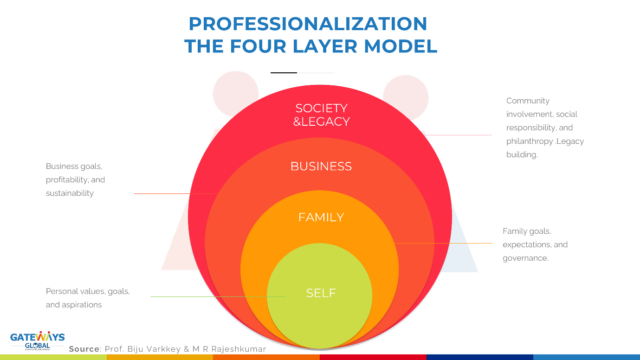
This scenario isn’t unusual. One of the biggest challenges family businesses face globally, and especially in India, is professionalisation. At GatewaysGlobal, we have studied this problem for years. Through our work with family businesses across Asia, we have identified four critical layers where professionalization must take place – Self, Family, Business, and Society. Together, these form the foundation of what we call the Four-Layer Model of Professionalising Family Business.

What is Professionalisation?

From a practical standpoint, professionalization means introducing systems and processes that ensure sustainable results. In the early stages of a business, the patriarch or founding members handle decisions directly. Systems may be informal, yet they function smoothly because control rests with one or two individuals. However, as businesses expand and the number of stakeholders increases, confusion and ambiguity arise.

Professionalization should ideally begin before these confusions set in. It’s far more effective and beneficial to start when operations are running smoothly than to wait until conflicts and inefficiencies emerge.

Where Does Professionalisation Begin?

This is often a “chicken or egg” question for families – should professionalisation begin with the business or with the family? Most families attempt to professionalize their business first. They hire senior professionals from MNCs or adopt new structures. However, these efforts often fail due to unclear authority, culture clashes, or conflicts with family management. Others try to professionalise their image through CSR or philanthropic activities to project an impression of professionalism. While well-intentioned, these efforts are rarely sustainable if not backed by deeper structural changes.

Through our research and experience, we have identified that the most impactful and sustainable starting point is not the business but with the SELF. When the leaders themselves professionalise, the rest of the organisation will naturally align and follow.

Professionalising the Self

The “self” refers to the individuals who lead the business – the patriarch, matriarch, or next generation leaders. Professionalising the self requires shifting from the mindset of founder-owner to founder-CEO.

This transformation rests on three aspects:

1. Behaviour – Shifting from owner-centric to business-centric actions. For example, valuing time as a CEO does by structuring schedules, giving appointments, and respecting others’ time, etc.

2. Systems and Processes – adhering to consistent systems, rather than decisions based on personal whims.

3. Relationships – nurturing relationships with employees, vendors, and partners as long-term collaborators rather than personal dependents.

Such a shift does not happen automatically. It requires conscious effort, exposure, and personal willingness to change. Habits built over decades, such as walking into the office late or setting informal work norms, take time to unlearn. But when leaders demonstrate discipline and professionalism, it sends a strong message to their team and lays the foundation for a more professional culture in their organisation.

Executive Coaching

A key enabler in the journey of Professionalising the Self is Executive Coaching. Leaders often say they are “lonely at the top” because they are hesitant to share doubts or struggles with family or employees due to fear of judgment. An Executive Coach acts as a thought partner, providing a confidential, non-judgmental space where leaders can reflect and arrive at their own solutions.

In family businesses, where multiple members may hold senior roles, coaching can also help navigate complex dynamics. It is increasingly common for both current and next-generation leaders to seek coaching, not just as a sounding board, but also to build leadership authenticity, refine their image, and strengthen executive presence.

Mentoring

Unlike Coaching, which is more facilitative, mentoring draws on lived experiences. A mentor who has successfully navigated professionalization in a family business can guide a leader through challenges and provide practical wisdom.

Psychometric Assessments

Self-awareness is a necessity for the Professionalisation of Self. Tools like CTPI-R from Central Test, which we use at GatewaysGlobal, help leaders identify their behavioral tendencies. For example, if a leader realizes they make decisions based on emotion, they can consciously develop a more rational, balanced approach. Such assessments strengthen competencies and provide a path for self-improvement.

Exposure and Learning

Another dimension of Professionalising the Self is exposure to global best practices. Many next-generation leaders participate in family business programs at leading institutions, which give them valuable networking opportunities and insights into how other businesses have successfully professionalized.

Conclusion

Professionalising the Self is the most challenging but also the most rewarding step in a family business’s journey of professional transformation. It is not about force- fitting behaviours. It is about evolving naturally and authentically. It requires consistency and the courage to question long-standing habits. When leaders begin to shift owner-driven decisions to business-driven decisions, the effect is profound. At GatewaysGlobal, we have seen how this shift in leaders is greatly supported with a thought partner by their side. This is why Executive Coaching has become such a valuable part of our work with family businesses.

To conclude, professionalization is not a one-time exercise. It is a 360-degree transformation involving mindset shifts, behavioural changes, skill development, and support systems. In the next edition of this magazine, we will take this series forward by exploring the second layer of our model: Professionalising the Family.


Family businesses are shaped by two intertwined perspectives. On one hand, they focus on products, markets, strategies, and revenue. On the other hand, they carry the weight of relationships, traditions, and unspoken expectations. Their true measure of success lies not only in the growth of the balance sheet but in the legacy they preserve and pass on across generations.

A family business is any business where ownership and decision-making are influenced by members of the same family. They may begin modestly with a store, a workshop, or a fish stall and evolve into a retail chain, a multinational manufacturing company, or a seafood exporter with market dominance.

What begins as a livelihood transforms into a legacy, carried forward through generations. In India, family business forms the bedrock of the economy. Several studies indicate that family-owned businesses account for a major part of our great nation’s GDP, underlining their scale and impact.

While it is true that family businesses are engines of growth, they are also vulnerable to unique challenges. Where legacy and emotions intersect with money and management, conflict is often close by. The success of a family business depends less on markets and capital and more on how effectively the family manages its own complexities.

Lack of governance and transparency is one of the most common issues in family business. In the absence of clear systems, personal disagreements have a way of seeping into boardroom decisions, blurring the line between what is best for the business and what is best for an individual. The blurring also extends to wealth. The thin line between family wealth and business wealth often becomes contested ground, giving rise to bitter disputes.

Another delicate issue is succession. When the question of “who will take over after the founder” is left unanswered or handled poorly, rivalries and resentment begin to surface.

Equally complex is the balance between professionalisation and control. While bringing in external managers can strengthen governance and sharpen strategy, families often hesitate to relinquish their influence, creating a push-and-pull between tradition and modern management.

Generational differences add another layer of tension. Older members may cling to stability and preservation, while younger ones press for innovation and change, creating friction that is both ideological and personal.

Above all, emotions run deep in every decision. Unlike in other businesses, a family cannot easily separate the father from the Chairman, or the daughter or son from the Director. Personal histories and unresolved dynamics inevitably spill into the boardroom deliberation, making choices as much about relationships as about strategy.

These challenges are not theoretical. They have played out dramatically in the stories of two iconic Indian companies – VIP Industries and Raymond.

The Gap in VIP’s Legacy – Succession Planning

In 1980, Dilip Piramal took over the reins of VIP Industries – one of Asia’s luggage giants. However, its deepest challenge didn’t come from competitors. It came from within. Like many family businesses, VIP never built a strong succession plan. The next generation had little interest in carrying the legacy forward, and without a clear plan, the baton eventually had nowhere to go. Piramal’s recent plans of exit from the company weren’t just about market struggles. It was also about the leadership void that formed when no successor was prepared or interested in taking charge.

VIP’s story is a reminder that building an empire is only half the journey. Ensuring it survives beyond the founder requires foresight, difficult conversations, and most importantly, succession planning.

The Raymond Dispute – The Cost of Poor Governance

If VIP shows the friction of succession, Raymond shows the fallout of poor governance and lack of transparency. Founded in 1925, it thrived under Vijaypat Singhania, who later handed control to his son, Gautam. What should have been a smooth transition became one of India’s most public family feuds.

In the absence of clear governance structures and transparent systems, disputes over authority and wealth quickly spilled into headlines. Vijaypat Singhania, who later handed control to his son, Gautam. What should have been a smooth transition became one of India’s most public family feuds.

In the absence of clear governance structures and transparent systems, disputes over authority and wealth quickly spilled into headlines. Vijaypat accused Gautam of sidelining him. Investors panicked not because of weak business fundamentals, but because personal disputes rarely stay personal. They ripple across shareholders, employees, and society.

The 5 C’s – The Pillars that Safeguard Family Businesses

To prevent ambiguity, enable perpetuity, and resolve these conflicts that erupt in family businesses, every family business should align itself with the Five Cs:

Culture – the shared values and traditions that bind the family and guide the business. The family should define its values and philosophy and ensure every family member religiously adheres to it all the time.

Consensus – the ability of family members to agree on business vision, process, and key decisions. “My way or the Highway” attitude will not work. Each family member’s voice matters.

Commitment – dedication to collective decisions, with every family member walking the walk and honouring what has been agreed upon.

Capability – building skills, leadership, and systems required to grow and adapt. The next generation should be given opportunities to learn, practice, and align their capabilities with the business’s growth and culture before taking on responsibility.

Continuity – ensuring smooth succession and sustainability across generations and creating an environment of perpetuity. Perpetuity is built through an environment of trust and small, meaningful actions that shape legacy.

When the 5C’s are aligned, family businesses thrive for generations. Every family member has the responsibility to understand and adhere to the proves set to implement the 5C’s in their family.

The stories of Raymond and VIP illustrate a truth: family businesses cannot always solve their challenges internally. The very bonds that make them strong also make honest conversations difficult. That is where advisors like GatewaysGlobal LPP play a crucial role.

Family businesses are powerful because they combine vision with values and resilience with relationships. But these very qualities also create fragility when emotions override structure. Success is not guaranteed by growth in the bottom line alone. It must be safeguarded by governance and professionalism.

With the guidance of skilled advisors, families can navigate these complexities, turning conflicts into clarity and succession into opportunity. The challenge of managing a family business is great, but so too is the reward of seeing a legacy endure.

(In the interest of confidentiality, all client particulars have been changed)
Client: Wonderweaves Limited

Challenge: Wonderweaves Limited, a prominent player in the textile industry, harbored a formidable vision of achieving 500 crores in revenue by 2024. Propelled by this goal, all the employees were fully geared up and worked smart to get there. Despite the best efforts put in by all the departments, the top management sensed that something was amiss. Individually each one was doing his/her best. Collectively, however, the organization was making only incremental progress and not reaching anywhere. Multiple rounds of discussions with HODs to understand the gap did not yield anything substantial.

Discussion: Recognizing the urgency and significance of addressing the problem, the top management of Wonderweaves Limited, after a careful market study and necessary due diligence, sought the expertise of People and Strategy Consultants, Gateways Global Human Capital Solutions to help figure out the missing piece.

Approach: After doing a thorough organizational diagnosis with our indigenously designed flagship diagnostic tool called OrgEfficience, Gateways Global understood that the company faced a critical challenge in leadership. The leadership team comprised a blend of homegrown talent and laterally hired executives. Demographically, the mix was good but functionally it led to a disparity in perspectives and viewpoints. The lack of synchronization between the two impeded the company's progress and threatened the realization of its ambitious goals.

After internal discussions, deliberations, and putting the team’s collective wisdom to work, Gateways Global curated a carefully crafted three-phase program. The objective of the first phase was to identify the current level of leadership capability. The second was to design and implement interventions based on the outcome of stage one. The third phase was to test the effectiveness of the interventions using specific tools.

Following our unique ICI approach, we did the following:

360-Degree Assessment: To get an idea of where the leadership team stands currently in terms of competencies, we suggested a 360-degree assessment. Also known as a full cycle assessment, this is an evaluation tool designed to gather feedback from various sources such as self, peers, supervisors, subordinates, and clients or customers. This comprehensive feedback provides a holistic view of an individual’s strengths, weaknesses, and areas for development, offering insights into their effectiveness in the workplace from multiple perspectives. To serve the purpose of the assessment, these stakeholders were meticulously chosen to mitigate the risks of familiarity, bias, resistance, fear, confidentiality, and limited engagement.

Theme Identification: Feedback responses from the various stakeholders were aggregated and compiled into individual reports containing both qualitative and quantitative inputs. These reports were analyzed to identify recurring patterns and trends in stakeholder perceptions. They also served to throw light on how the gap between the assessment outcomes was meticulously consolidated into a perception matrix that visually represented each leader’s self-perception vis-a-vis stakeholder perception. A gap analysis was done to identify areas of alignment and divergence.

Feedback: Each participant was given detailed one-on-one feedback in a supportive and constructive manner which helped clear blind spots and correct self-perception in relation to others’ perceptions. It also gave them insights into their own strengths and areas for improvement. This equipped them to prepare an individual development plan.

Color Coding & Relationship Mapping: For easy understanding of the Management, we created a color-coded framework that facilitated a clear understanding of the leadership landscape, highlighting areas for improvement and alignment. Each participant was color-coded as red, green, or blue depending on his/her competency score.

Once each participant was color-coded, we created a comprehensive relationship map, mapping each Head of Department with his/her respective teams. This mapping exercise enhanced clarity and provided valuable context for interpreting stakeholder perceptions, shedding light on the underlying dynamics and influences. Towards the end of the discussion, the hands on-CEO was even able to cite specific instances as to why certain stakeholders would have rated the participants in a certain way.

This exercise also helped the management to focus on teams where strategic realignment was needed to enhance trust, collaboration and mutual value creation.

Coaching: Tailoring our approach to individual competencies and areas of improvement, we designed customized coaching programs. The participants for the coaching program and were carefully selected based on a scientific coachability index. The Coaching team was put through a series of sessions. There was the first round of Team Coaching sessions to bring in team cohesiveness and focus on core development areas based on the 360 feedback. Then they were allotted business-linked projects to enhance collaboration and business focus. This gave them a shared goal to achieve while boosting productivity through synergy. It enhanced problem-solving and creativity. Next came One-On-One Coaching to focus on behavioral changes to enhance potential in the identified areas. This was followed up by the Second Team Coaching session to throw light on how to work around and manage biases. Project Assessment was done next to evaluate the status of the project by analyzing the contribution of self and team. The Second round of One-On-One Coaching sessions followed, and this served to further enhance potential in the identified areas. The third and final team coaching was aimed at establishing a Signature presence.

Effectiveness Evaluation: We used the 180-degree evaluation to test the effectiveness of the training sessions, cross-functional projects, and coaching programs periodically, assessing the impact on the individual’s performance and behavior with stakeholders, and monitoring the individual’s progress toward his goals. Wherever midcourse corrections were felt necessary, we made them, to ensure continuous growth and development.

Outcome: Through our strategic interventions, Wonderweaves Limited witnessed a remarkable transformation in its leadership dynamics. The once disjointed leadership team evolved into a synchronized force, equipped with the necessary skills and insights to drive the company towards its ambitious vision. Specifically, the following areas showed remarkable improvement.

Employee Engagement scores increased from 55% to 78%, indicating a 42% improvement in the overall organizational culture as perceived by the employees.

People’s capability increased in terms of leadership effectiveness scores from an average rating of 6.5 to 8 on a scale of 10, reflecting a 23% improvement in leadership capability. In terms of skill enhancement, the percentage of employees exceeding skill development targets rose from 60 % to 85%, showing a 42% enhancement.

Collaboration- Survey feedback indicated a 40% improvement, measured by the increase in positive responses regarding the ease and effectiveness of working across teams.

Revenue Growth-Prior to the intervention, annual revenue growth was trending at 10%. Post-intervention data showed an increase to 15%, representing a 50% increase in growth rate. As a result of our collaborative efforts, Wonderweaves Limited not only surpassed its revenue target of 500 crores ahead of schedule but also fortified its position as an industry leader.

Conclusion: The case of Wonderweaves Limited exemplifies the pivotal role of effective leadership in navigating internal challenges and achieving organizational goals. Our signature Coaching style of empowerment through insight enables everyone to unlock their full potential through a deeper understanding of their own behaviors and motivations. Hence, it’s a personalized path to success tailored to the unique needs and aspirations of each individual. We strictly adhere to the ICF credentials with its commitment to integrity, understanding, and mastery of coaching skills. These credentials are globally recognized and respected for their high standards of education and ethical practices. By partnering with our consulting firm and embracing a holistic approach to leadership development, Wonderweaves Limited not only overcame its crisis of leadership but also emerged stronger and more resilient in the face of future challenges. As organizations continue to evolve in an increasingly complex and volatile world, investing in leadership development is no longer a matter of choice but an imperative for sustained growth and success.


Many family businesses in India have a tradition of business established for problem-solving and community service rather than just profit. These businesses, grounded in tradition and family, have thrived, endured and grown over generations. But this legacy has not sustained a lot of family-owned businesses in recent years. Now, Venture-capital funded Startups and multinationals (MNCs) have become new challengers for family businesses. These newcomers have shaken up conventional industries and lured talent from family owned business with modern organization and practices.

If family businesses do not change their modes of operating, they will lose market share to MNCs and startups. Working on your family business helping to gain competitive advantage and survivability is the million dollar question today.

Family businesses are recognized for their cohesive, distinctive culture that is largely influenced by the founder’s objectives, approach and philosophy. The result of this culture is harmony between personnel workers, creating stability and dedication to the organization. However, in a turbulent business environment characterized by constant change, family businesses need to ask whether the cultural underpinning behind the family firm is still geared towards productivity.

While in an everchanging business environment where transformations and business model disruptions are a fact of life, every family-owned business must ask itself whether its culture is fit for purpose. The silver lining is that what most affects a company’s culture, health and potential can be measured, so executives can seize new opportunities. As business leaders, we help identify the gaps, and our OrgEfficience tool helps analyse those gaps to arrive at better solutions.

Based on GatewaysGlobal’s experience supporting family businesses, we have regularly observed that successful family businesses particularly flourish because they embody a cohesive, unique culture, which is strongly shaped by the founder’s purpose, approach and philosophy and embraced by the employees. Such cultures unite employees around a shared mission, creating dedicated and stable workforces.

 Purpose and Philosophy

In the early stages of a family business, leaders usually verbally express their purpose to employees. This purpose as guided by the founder philosophy, is a strategic business driving force. This mirrors the underlying core values and decision-making mechanisms that guide daily operations. This strategy may work for smaller businesses, but the need to formalize these elements increases with organizational growth.

Such philosophy should be established, documented, and communicated in writing to ensure that the organization’s philosophy that composes vision, mission, and core values are enforced causing people to change how they behave and think. By having a decisive vision and mission, with significant values, the focus of the organization can be directed towards a specific effort leading to an engaged labor force.

People Management Systems

Family businesses are often resistant to putting in people in strategic roles, such as finance or human resources, who come from outside the family amongst anyone else. Such outdated practice can obstruct building up strong people management systems. Becoming an “employee friendly” organisation is made possible by formal people management systems. Get people management system right, and it can help you hire the right talent, allow meritocracy, make compensation attractive and help in fair system of managing people.

Translating to a modern people management system can help family businesses attract and retain talent, which has always been a challenge. A well-structured people management system not only helps the business assemble a talented team, but also gives the existing family leaders a system to identify and prepare the next generation, ensuring a seamless transition while developing the next generation for leadership roles.

Succession Planning

One of the biggest challenges encountered by family business is succession planning. Many family businesses are eventually passed down, handed down to the next generation. However, while some transitions go smoothly, in the majority of cases, the transition can be fraught with problems if we do not manage the transition process properly. At GatewaysGlobal, we have heard many stories about how succession planning has led to disappointment among senior leaders, who often feel overlooked and pushed to the side.

Succession planning is much more than simply filling leadership roles with family members. What it really needs is a holistic plan designed to accommodate the unique needs of a specific family business advisory and to help ensure a seamless succession, as well as to ready the next generation to take over the reins. Family businesses need a succession plan, striking the right balance between the interests of the present-day leaders and those of the next generation.

Conclusion

Today’s dynamic business environment leaves family businesses management of their own. But if they devote themselves to developing a strong vision, mission and values, building robust people management systems and designing clear succession plans, these businesses can happily navigate modern market landscapes and ensure their continued success.

Using a simple but powerful framework, GatewaysGlobal helps family businesses articulate their current culture, identify elements they may want to change and track progress toward a new vision, mission and values.

Considering the uncertainties of today’s economy, family businesses are grappling with a unique challenge of balancing traditional values with the necessity of both innovation and competition. Good governance can bring that balance, as businesses can protect their culture while seizing new opportunities. Our research indicates that without governance structures, there is confusion and reduced growth. Below are some of the key reasons why a governance structure is not only beneficial for family businesses in maintaining their innovative edge, but also vital to ensure they honour the mission and vision of the founders:

Setting Up Clear Governance Structures

It all starts with a solid governance base within family businesses, in the form of a family constitution or a succession plan. These models give extrapolated structure around which to build roles, responsibilities, and decision-making processes, permitting leadership an opportunity to innovate whilst unburdened from operational challenges. Smoothly transitioning businesses to the next generation can keep companies relevant to changing marketplace conditions, and true to established principles.

Fostering Open Lines of Communication

Family businesses in which family and non-family members can talk freely with each other become places of innovation. Good communication structure makes meeting regular and feedback channels clear to avoid misunderstanding and let ideas flow freely. Alignment guides innovation, so that when you identify and slot strategy into your goals, you can bring in people and ideas to integrate with your company philosophy.

Growing While Defending Family Interests

Policy frameworks help separates matters of personal and business interest to create an environment where decisions are made based on the organization’s long-term needs as opposed to family influences. This separation frees those businesses up to focus on innovation and growth, safe in the knowledge that the company’s strategic decisions won’t be made on a whim or in pursuit of some personal gain in the short term, but with one eye on the future. The two need to be separated to allow the family to continue to function as a unit with an eye towards sustainable growth.

Championing Diversity and Inclusion

So, in a climate of well-structured governance framework, diversity and inclusion thrive which are the key drivers of innovation. Family businesses that value a range of viewpoints have a better chance at producing innovative responses and responding to shifts in the marketplace. Offering a platform for diverse perspectives adds a layer of innovation that supports the mission of the company rather than undermining it.

Embracing Modern Technology

The legacy of many family businesses lies at the intersection of tradition and innovation—one where modern technology is integrated into governance frameworks to improve decision-making and operational efficiency while staying true to core values. Leading companies combine artificial intelligence and data analytics to provide actionable insights, automate tedious tasks, and forecast market trends, enabling leadership to leverage their time for visionary thinking. Governance that encourages new technologies allows enterprises to outpace their competition without losing touch with their traditions.

Conclusion

Such trading in family businesses management is near inevitability in this hyper-competitive business landscape where a proper governance structure should be essential to keep family businesses thriving — without compromising the legacy and values that have defined them all these years. It allows these businesses to direct their energy towards innovation and growth, rather than get derailed by internal issues.

Visit GatewaysGlobal LLP to Learn More on How Governance Can Benefit Your Family Business!

WhatsApp Image 2025-03-11 at 11.49.45_8b09aa4d

The experience of working with a new client recently gave us a first-hand feel of how the achievement of Organization suffers when the employees are not aligned with the organizational goals and vision. Be it alignment of the organizational vision, employee engagement or a positive work atmosphere, effective communication is quintessential for an organization.

To understand the importance of that, we will dive into this subject with the help of a case study. Consider a case study wherein TechnoJungle Innovations, a mid-sized IT Services firm, was able to successfully implement a holistic communication channel to handle pain points around vision casting, employee engagement, morale and loyalty.

Background: TechnoJungle Innovations had a few challenges such as the disconnect between organizational vision & departmental goals, low employee engagement, declining morale, and increasing turnover. In response to those issues, the leadership team brought in GatewaysGlobal team to implement a new communication channel aimed at creating better clarity, engagement, and employee satisfaction.

Path: Developing strong communication channel that is in line with function goals, which increases employee engagement to improve morale and loyalty across the bottom line.

Methodology

My consultants used their OrgEfficience – an Assessment tool designed and used by them to understand the processes, policies, procedures and systems of the organization in 5 days. Our tool is used for assessments diagnose organizational problems like; understanding of organization goal, employee engagement, understanding of HR policies, grievance management, workflow inefficiencies, team dynamics, effectiveness of leadership, etc.

An in depth report from our Consultants after the assessment. The following is a list of known issues / concerns.

1. Some communities offer data on their organisational structure and hierarchy.

  • Top-Down Communication: Communication was predominantly top-down; employees were disconnected or unaware of decisions and changes. Somehow the communication did not / l the Project Managers / Team Leads (middle management) level in the organizations
  • Siloed Departments: The majority departments worked in silo’s. Lack of collaboration among department.

2. For more than five hundred thousand staff, unfortunately, our channels of communication suffer.

  • Poor Tools: Most communication used to happen on emails. The organization employees were using a common ID’s for emailing which created communication gaps and created gaps within employees – some updated about the changes in the organization and some un-updated.
  • No Standardization: There were no communication standards, so the grapevine communication was at its best. “It was not clear how or when employees should share information.

3. Issues in Leadership and Management

  • Bad Middle Management: The middle managers were generally not the best communicators. They were in the organization for a long time so they faced difficulty in communication in new age mode.
  • Inconsistent Messaging: The Project Managers / Team Leads were giving inconsistent or unclear messages which resulted in a lot of confusion and dissatisfaction.

4. Employee Engagement & Staff Morale

  • Disengagement: Because employees had absolutely nothing that they knew about the organizational mission, expansion plans, etc., they become disengaged or dissatisfied with their roles. In the end, it resulted in them being less involved in most of the engagement processes.
  • Risk of Backlash: Employees held back their voice and did not share their opinions considering that the organization was not aware of policies. They were concerned that, if they approached them directly, there would be repercussions from the management.

Conclusions

At GatewaysGlobal, we understand that every organization is different – each organization, like humans, has a unique DNA. That is why we think outside the box and develop custom solutions for each client that we service. There were a myriad of steps we took to resolve this that included vision alignment workshops, Townhall, Newsletter, was to have a performance management system in place, running engagement programs, and getting involved with Cross Functional Teams. While these initiatives contributed towards greater employee engagement, improved morale & loyalty, the results were also visible on TechnoJungle’s bottom-line which had stagnated for 3 consecutive years.

Are your employees aligned to your organization’s vision? Avoid falling into this trap and let communication overcome the barriers. Utilizing Enneagram and other psychological tests, co-create systems and processes customized for the collective energy of the group are relatively fast to execute. Together, let’s transform your organization. Contact us today!

5-factors-that-are-killing-organizational-efficiency

In the modern competitive landscape, organisations are attempting to perform at a high level to remain ahead in the race. These can lead to inefficiencies despite their best efforts and are a barrier to growth, productivity, and profitability. This can cause wasted resources, ineffective results and low morale among your employees.

To address these issues, organisations will require a formidable solution that enables the diagnosis, analysis and optimisation of their performance. The tool is known as OrgEfficience and is indigenously built by GatewaysGlobal, which aims to assist organisations in identifying gaps; address the areas of inefficiency; align their strategy and processes to achieve peak performance.

In our experience, Various Top 4 challenges are blocking organisational efficiency of one or the other organisation – As a reliable consulting partner for numerous organisations, we have observed these 5 factors which most of the organisation is facing.

1. Poor Communication

It is misunderstanding, mistakes and delays that are often caused by better communication or poor communication channels. When teams aren’t aligned on goals or processes, they end up duplicating efforts or losing critical details. Miscommunication causes ripples throughout the organization, affecting decision-making capabilities and reducing overall efficiency. Transparent communication is the most crucial element when it comes to a team sharing information and collaborating on tasks without ambiguity.

How does OrgEfficience help: OrgEfficience assesses where people, processes, and strategies align, what gaps in communication exist between annexes, and prescribes steps that can facilitate smooth and transparent collaboration. It is thus an important step towards building an environment of collaboration and communication, both through departments and levels.

2. Lack of Employee Engagement

Lack of motivation employees can make them less productive, which negatively contributes to overall performance. Employees who see themselves as disconnected from the organization’s mission or are convinced that their work is not valued have lower engagement.

This disengagement can lead to increased turnover, decreased morale, and reduced innovation. To maintain productivity, organizations must develop an environment in which employees feel empowered and essential to the company’s success.

OrgEfficience: Reconciling People and OrganisationHow: It helps you in knowing where your employees feel disengaged, underappreciated or unsupported. This tool goes beyond the surface to provide actionable insights that, when implemented, enhance employee experience, drive motivation and create a sense of belonging by digging into the culture and leadership practices in your organization. which leads to more audience involvement. These insights enable organisations to implement targeted strategies to enhance employee engagement, retention and overall well-being, which can ultimately contribute to business success

3. Inefficient Processes

Workflow systems can be quite restrictive too—outdated practices, duplicate entering of information, or lack of clear procedures can impact efficiency greatly. Time is wasted. Tasks are done that no longer add any value. Tools and methods that are past their prime are battling the team. This results in organizations wasting time and resources, since there is no process optimization. Conduct regular reviews and updates to workflows and eliminate bottlenecks as they appear.

Our Solution: OrgEfficience is here to help, identify processes that are draining precious resources, and frustrating employees. By analysing workflows, procedures and systems, the tool highlights areas of redundancy, bottlenecks and waste, offering a clear roadmap for process optimisation. Organisations can use these insights to remove redundant/redundant steps, automate manual processes, and reimagine workflows to achieve higher efficiencies, cut costs and increase customer satisfaction.

4. No absolute objectives and guidance

If employees do not fully understand what they are working towards, or how their tasks contribute to organizational success, motivation decreases. Without clear goals, employees will feel like they are in a vacuum, not understanding the larger purpose of their work. Such misalignment results in useless expenditure of resources and energy, as people or teams may chase contradictory or irrelevant objectives. Having clear, attainable objectives to strive for can help steer efforts and keep everyone aligned.

OrgEfficience: How OrgEfficience Helped: Our tool identifies a gap between organisational strategy and objectives, and day-to-day operations, to clarify the goals and direction of organisations. It assesses the organisation’s mission, vision and values, and its goal-setting process to identify gaps and misalignments. Organisations, with this knowledge, can articulate their mission, define their outcomes in a simple and achievable way and ensure that everyone is aligned to the same strategic priorities. They have then practice by doing this they will bring clarity and allow themselves to really drive focus, productivity and ultimately better results.

5. Poor Resource Allocation

Poor resource management—be it time, money or people—can quickly create bottlenecks and block progress. Overworked, underfunded and unprepared teams fail to deliver results. Properly managing resources means that each team has what they need to accomplish their goals. Organizations should take a step back to regularly assess where their resources are going, and course correct to make sure that the people, time and money they have at their disposal are being most effectively deployed to drive performance.

How OrgEfficience Assists: This tool provides visibility to make poor resource allocation, which is a major roadblock for achieving business objectives, visible. The tool identifies inefficiencies and misallocation and waste by analysing how resources such as talent, technology and budget are being employed. Salvaging this information, organisations can redistribute resources in accordance with strategic priorities, removing waste and optimising investments made on people, processes and technology. Organisations can maximise ROI by taking informed decisions on making resource investments with an aim to improve productivity and enable sustainable growth.

All of the above pain points may feel absolutely debilitating and when they come together, you feel like you are being pulled in the opposite direction of what you want. But, imagine if you had a tool at your disposal that would allow you to overcome these issues and leverage your organisation to its fullest potential? OrgEfficience does exactly that and by utilising our propeller tool you can help to streamline processes, remove ambiguity on goals and direction, and improve engagement and productivity.

NULL